
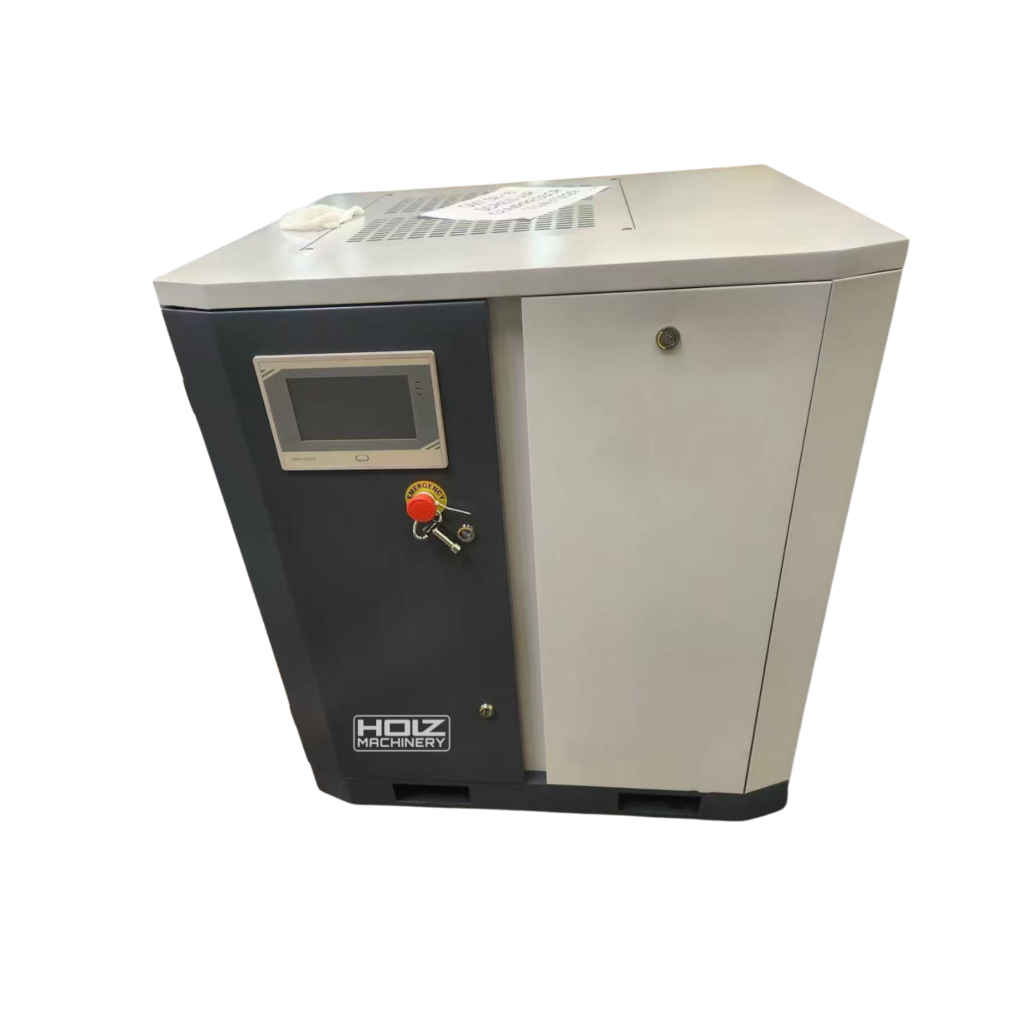
Choosing the right compressed-air technology affects productivity, energy bills and downtime. For many industrial and workshop applications, modern rotary screw compressors deliver superior real-world value compared to traditional piston (reciprocating) compressors. Below we explain how each works and lay out seven practical advantages that make rotary screw compressors the preferred option for continuous, heavy-use environments.
How the two technologies differ
Rotary screw compressors trap and compress air by the continuous rotation of two helical rotors (the “screws”). Oil-flooded screw designs use oil for sealing, cooling and lubrication and then separate it from the compressed air.
Piston (reciprocating) compressors compress air by pistons moving back and forth in cylinders; compression is cyclic and relies on valve assemblies that open and close each stroke.
7 advantages of rotary screw compressors
1. Smooth, continuous airflow (no pulsations)
Screw compressors deliver a continuous, non-pulsating airflow because the rotors rotate continuously. That steadier pressure improves tool performance and eliminates the significant pressure pulsation and vibration that reciprocating designs generate — often requiring extra silencers or vibration mounts for piston machines.
2. Lower vibration and quieter operation
Because screw compressors use rotary motion rather than high-acceleration reciprocating parts, they typically produce less vibration and can be more easily sound-enclosed. Piston machines’ parts lists commonly include noise suppressors and vibration dampers, which is a direct indicator of the acoustic and mounting challenges with reciprocating units.
3. Built for continuous, heavy-duty use
Rotary screw airends are designed for long run times and continuous operation; manufacturers back that up with extended airend warranties and industrial-duty documentation. That makes screw compressors ideal for multi-shift facilities and production lines.
4. Lower maintenance frequency and fewer wearing parts
Screw compressors have fewer moving components (no pistons, connecting rods and numerous valves), and manufacturer service schedules show long intervals between oil checks and changes. That reduces downtime and lowers lifetime service costs compared with piston units that carry numerous valve and piston spare parts.
5. Energy savings with VSD / smart control
Screw compressors pair very well with variable speed drives (VSD/VFD) and advanced controller logic to match output to demand — a major energy efficiency win. Your controller and compressor manuals reference VFD hardware and energy-saving kits, demonstrating how modern screw systems reduce wasted motor hours and cut operating costs.
6. Compact, integrated packages
Modern rotary screw units are highly integrated (airend + oil separator + coolers + controller), which saves floor space and simplifies installation. Controller manuals highlight “high integration” and reliability as design goals — useful when space and system simplicity matter.
7. Lower lifecycle cost for production environments
Though piston compressors can have lower up-front prices for small, intermittent needs, screw compressors typically win the total-cost-of-ownership race in continuous industrial settings due to energy savings, longer intervals between services, and lower downtime risk.
When a piston compressor still makes sense
Piston compressors remain a good choice for:
- Infrequent, light duty (hobby shops or small garages)
- Low budget / low average usage where upfront price is the critical factor
- Very small systems or very high instantaneous pressure bursts in select cases
Parts and manuals for piston machines frequently show many piston/valve components and noise management parts, which explains their suitability for small, intermittent roles while highlighting tradeoffs for production use.
Quick decision checklist
- Multi-shift or continuous production → Rotary screw
- Steady high air demand or need for quiet operation → Rotary screw (with VSD)
- Occasional use, low air volume, small budget → Piston
- Want lower lifecycle cost and fewer service visits → Rotary screw
FAQs
Q: Are rotary screw compressors quieter than piston compressors?
A: Generally yes. Screw units run with less vibration and fewer impulse noises; piston machines often need silencers and dampers.
Q: Do screw compressors save energy?
A: Yes — paired with VSD/VFD and modern controllers, screw compressors can match output to demand and save substantial energy.
Q: Which has lower maintenance costs?
A: For continuous industrial use, screw compressors typically have lower maintenance frequency and fewer replaceable moving parts.